










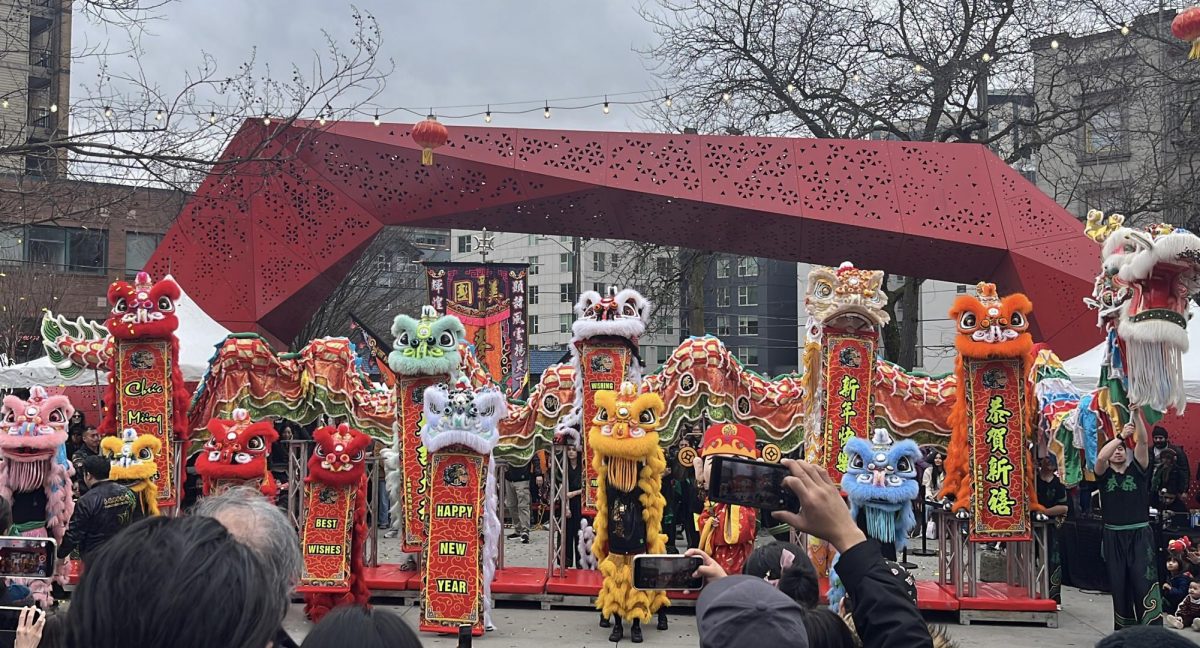
The Year of the Horse arrived in the cold of winter, bringing celebration with it across the world. On March 7, the Seattle Chinese and International District (CID) held its annual Lunar New Year celebration. Pop-up booths crowded King Street from the Wing Luke Museum down to Fifth Ave.
Performances filled Hing Hay Park through the evening. People roamed the vendors and cheered on the performers as music echoed over the crowd.
This beautiful celebration brought Asian cultures into the spotlight, honoring long-preserved traditions. However, with the continuous existence of cultural appropriation and bigotry flaring, it reminds us all of the community that lives and thrives in the same spaces as everyone else. Asian culture has maintained a strong presence on social media and public attention, attesting to how fascination leads to awareness and appreciation.
Yet, this fascination also exposes the normalized micro-aggressions that are prevalent in communities often tokenized in popular media, and this tension subtly perpetuates harmful stereotypes that promote discrimination in society.
When the pandemic sent the world into lockdown, a wave of aggressive hate revived discrimination and distaste toward the Asian populations. It villainized Asians and Asian Americans by pointing the blame at food, culture, tradition and the people themselves.
In an ironic twist, Asian food that was once perceived as distasteful, especially during the COVID19 pandemic, has evolved into high demand cuisine, loved and explored across the nation. This includes boba, matcha, tanghulu and much more. Unfortunately, the uprising has brought with it inconsideracy as people change the traditional recipes by adding their own elements and rebranding traditional dishes as a “new discovery.”
While this isn’t insulting on its own, when those same people fail to acknowledge the origins of the dishes, they disrespect the communities who established deep cultural roots.
The viral food trend of “Courtney Cook’s eggs” recently shed light to this. TikTok influencer Courtney Cook, who posts diverse food combinations, encouraged millions of viewers to try her cooking recipes. One of her viral food trends, marinated soy sauce eggs, has influenced many non-Asians online to try the recipe.
However, this viral recipe had many commenters arguing about misattributing and dishonoring the roots of Korean culture since the dish is closely related to “mayak eggs,” a traditional Korean dish. Followers and numerous content creators who followed her recipe, conveniently began calling this traditional dish as “Courtney Cook’s eggs,” despite its cultural significance.
Though Cook has given credit to Korean culture for the recipe in a TikTok video responding to the tension, on a broader level, it has triggered many Asian communities to feel indignant.
As Asians, seeing something long rooted in our culture suddenly being celebrated because a white person simply engaged with and became trendy feels bittersweet. For those who grew up with first- and second-generation parents during the late ‘90s and early 2000s who packed our lunches everyday, the experience stirs the inner child buried in our Asian American identity.
The unspoken trauma in our childhood of being culturally shamed into suppression in a predominantly white society has taught us to guard our spaces and traditions. That weariness of alienation and discrimination is intergenerational and contributes to the reactions we see today, despite the different forms it appears in.
Recently, a similar controversy on TikTok emerged with the #HmartGirl (also called #HmartGate). This trend sparked the same sentiment from “Courtney Cook’s eggs.”
As non-Asians—specifically white people—more frequently started going to H-Mart, a Korean grocery store, it started being perceived as a tourist attraction. Influencers reacted to produce and products as if they were exotic oddities that couldn’t possibly be edible.
As the continuous disgust in foods that aren’t “trending” grew, the Asian community became more defensive around non-Asians shopping in Asian grocery stores. This is why we see distrust becoming more noticeable as resentment grows.
The “side-eye” from Asians towards non-Asians as a reaction to this trend is a direct product of this resentment. For many Asian families, groceries like H-Mart are a safe space. They are parts of our cultural identity which come from food, community and places we grew up with.
This discourse reflects a larger societal issue of Asian culture being exoticized and selectively validated. Though some non-Asian influencers interpret this reaction as gatekeeping and being accused of racism, to Asians, this is pure satirical criticism.
This goes in opposition to the Model Minority Myth, which is the belief that Asians are a “model race” who are overly intelligent and obedient people, striving to benefit American society without disrupting norms. Although the promotion of this belief has slowed significantly as we move forward, it is still very present in popular opinion, and harmful to Asian communities as it pressures them to conform or risk criticism by standing out.
Looking at both of these cases, Asian Americans defy this stereotype. We aren’t silent or passive; we can critique social norms and assert pride in our cultures.
This seemingly lighthearted social media commentary connects back to a larger historical context of racial stereotyping, and these are forms of resistance against longstanding narratives that try to contain Asian American identity.
Additionally, the recent trend of influencers claiming they are reaching “a very Chinese time of my life” has provoked outrage in the Chinese American community. Chinese Americans are forced to watch non-Chinese people claim the right to call themselves Chinese because they ate dumplings or learned to use chopsticks during lunar new year celebrations.
Though this trend began as a benign and laughable joke, more serious issues grew and Chinese Americans found themselves arguing that their identity isn’t something a person can just decide to claim overnight. Respecting culture is not the same as deciding to take it as your own when convenient.
As of 2026, our school is 71.1% white-dominant, 11.4% are mixed race and 4% of students are fully Asian, according to US News & World Report. Asian American identity has never truly been acknowledged in our education, along with other ethnic groups.
As students, we’ve observed the absence of ethnic studies that could recognize not just Asian culture but many others that have built America to what it is today. This lack of representation promotes perpetual foreigner syndrome, the idea that marginalized groups will always be considered as outsiders.
Though our school has been working to educate students on this diversity through heritage months, there needs to be conversation about integrating cultural awareness and history into the curriculum year-round. Heritage months are a significant way to promote this education, but it is not the answer to this longstanding systemic issue.
As they currently function, these “celebrations” confine the recognition of different ethnic groups to a single month including Asian, Black, Latinx, Indigenous, and more. Yet, these histories are American history. The contributions and experiences of all these communities should be incorporated into our core curriculum in addition to having the option to learn more if students choose to through ethnic studies.
During a time of deep political polarization, it is more than important to come together rather than trying to promote more division among communities. What we need right now is a call to action for awareness and respect for cultural identity and practices.
Unfortunately, discrimination will always exist because everyone has implicit biases—the unconscious practice of stereotyping that influences our perspectives and in turn our actions. But we cannot continue to normalize villainization of ethnic groups, and this is not limited to only Asians.