









Family history and the positive reputation of the school’s math program influenced Inyoung Jung’s decision to teach at the school.
“A lot of my family and friends have gone to Ballard High School,” Jung said. “That was one part. Another one is that I’ve heard really good things about the math program here in terms of the staff and the team as a unit.”
The community in the math pod allows for connection among teachers.
The math teachers have been really uplifting,” Jung said. “They check in often. As a new teacher, it’s really easy to be stuck in your classroom because you don’t really know other teachers. I feel very comfortable just walking into anybody’s room.”
The school staff has welcomed Jung with open arms, helping him through the transition into teaching at a new school.
“[The staff] have been super supportive,” Jung said. “They’ve been really helpful in terms of guiding me on what I need to know, and what I need to focus on, and helping me with the curriculum. I’ve had a really good experience so far.”
Jung’s appreciation of the benefits of hard work and perseverance contributed to his decision to teach math.
“I’ve always enjoyed the difficulty of math,” Jung said. “I’ve always liked difficult things, like hard puzzles or something that requires effort and struggle. Math was definitely one of those things.”
Changing the narrative of the negative reputation of math class is something that Jung focuses on in his teaching.
“I find that the way math was done in the past, it kind of sucked the joy out of it,” Jung said. “I want math to also be a fun subject, not one of those subjects that people avoid, but one of those subjects that empowers people, rather than stress them out about it.”
Sophomore Carli Pecoraro, who is in Jung’s Algebra 2 class, has experienced math classes with teachers less enthusiastic about student connection, which she has noticed is a stark contrast to Jung’s teaching.
“In the past I’ve taken math classes where the teachers don’t care as much, and they don’t want to help as much,” Pecoraro said. “I think he’s doing a good job of communication and teaching in a way that caters to everyone.”
While academic growth is important, Jung is also motivated to help students find their confidence in other aspects of their lives.
“I just like helping people,” Jung said. “I like seeing the growth in the students in terms of their academic, emotional and even social growth. I really enjoy seeing student’s confidence grow, and seeing how much they change and how many skills they pick up at the end of the year. It’s a really joyful part of teaching.”
Sophomore Cameryn Helman has connected with her peers in Jung’s Algebra 2 class because of his community-oriented teaching style and focus on collaboration between students.
“He makes us work in groups, which is good for communication, and bonding,” Helman said. “I think that’s his whole thing, is getting to know people so they can help you understand. It’s easier to ask someone questions if you already know who they are.”
Social connections are important to academic growth, as students can lean on their peers for help and collaboration.
“You really get to know your table group,” Pecoraro said. “If you don’t trust your table group, you’re not going to work well together.”
Connections between table groups are similar to connections between the classroom community as a whole.
“Students have been very respectful to my expectations. So far, I think we’ve built a community in the classroom where we feel supported by each other, and supported enough to share with each other.”
Students have noticed Jung’s attentiveness and efforts to connect, which has contributed to the cultivation of a tight-knit classroom community.
“He goes to each table and he’ll look you in the eye when he’s speaking to you,” Helman said. “He doesn’t look distracted, and he actually tries to come up with interesting questions and responses.”
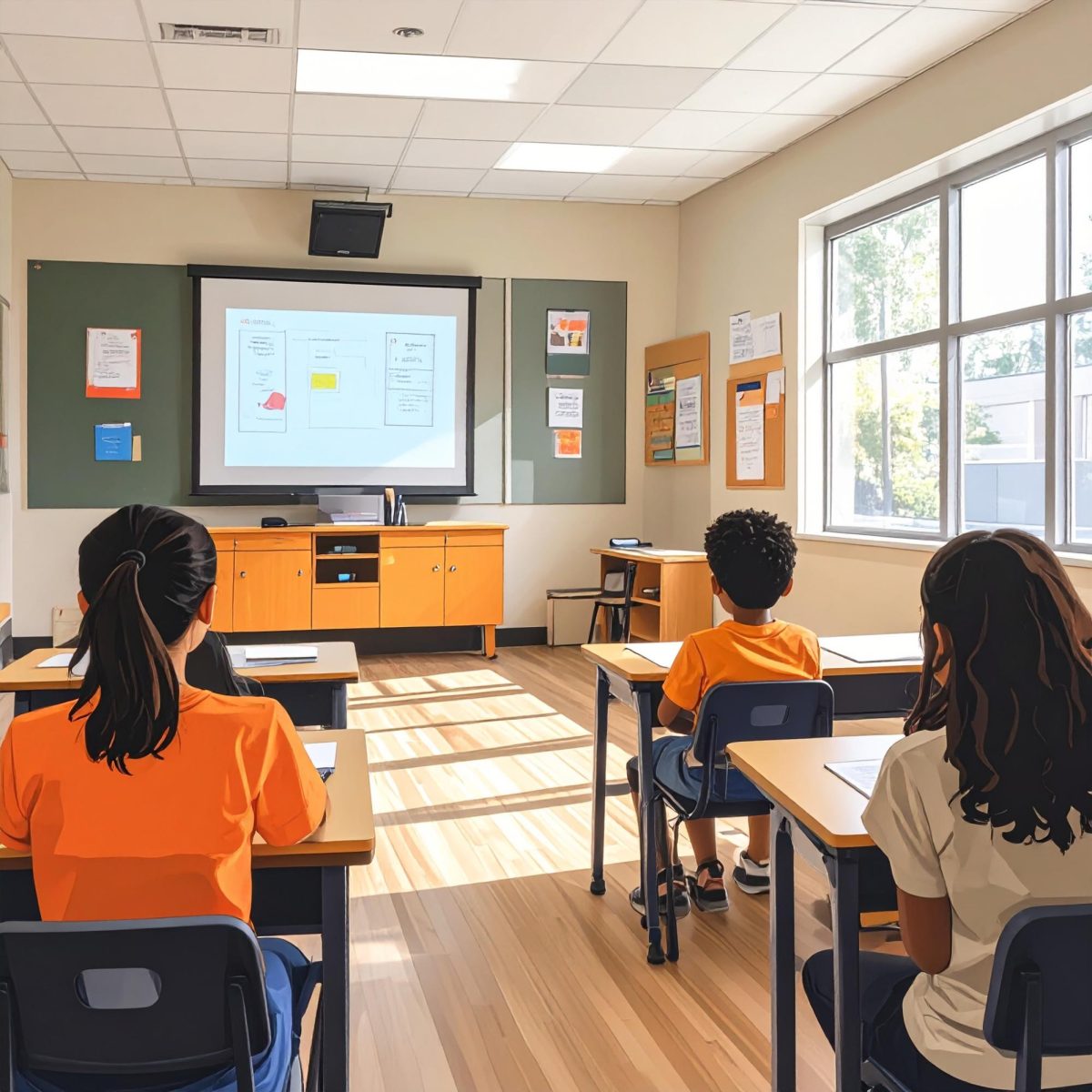
During class, students are given ample time to work on the worksheets that they are assigned as homework, which benefits student learning.
“Sometimes when you’re doing the homework at home and you don’t understand, then you’re just stuck and you can’t do anything,” Pecoraro said. “ So it’s nice to do it in class, because there’s someone to help you.”
When students have questions, Jung will take the time to walk them through a solution.
“He’s good about answering questions, and not just saying ‘just ask your table group,’” Pecoraro said. “If you have a question, he’ll help you with it.”
Along with connecting with students in the classroom, Jung connects with the school community through being a club advisor.
“Right now, I’m an advisor to a ski club, but I hope to become a coach eventually. It’s been pretty fun to see students out of the academic realm and see the things that really drive their passion, and [to see] something that connects so many students together. I think that’s a really fun part of that.”
Teacher involvement in clubs is an essential part of the community, and connection with students can encourage participation.
“I think teachers build up the main structure of clubs and make people feel invited,” Helman said. “The way that Mr. Jung is there for people is the kind of thing that makes others feel invited to join those clubs.”